

Targeting
Vulnerabilities are identified — trauma, isolation, mental health needs, substance misuse, housing instability. The perpetrator selects the victim strategically.
Friendship
Gifts, money, drugs, affection, belonging. The victim is made to feel special, protected, chosen. Trust is built. The victim does not feel at risk — they feel cared for.
Relationship
A sense of tribe, loyalty and dependence develops. Isolation from family and other support networks begins. The perpetrator becomes the primary attachment figure.
Abuse
The victim is used for the perpetrator’s gain — drug running, sexual exploitation, property takeover. Fear, debt bondage and blackmail are used to maintain control. Disclosure feels impossible.
Sexual exploitation – being pressured, coerced, or manipulated into sexual activity for another’s benefit.
Criminal exploitation – being forced or coerced into criminal activity (e.g. drug dealing, theft).
Financial or material exploitation – misuse or theft of money, benefits, property, or possessions.
Modern Slavery – human trafficking and / or slavery, servitude and forced or compulsory labour.
Labour exploitation – forced or unpaid work, often under threat or with no real choice.
Domestic servitude – being forced to provide domestic work under controlling conditions.
County lines exploitation – coercion into transporting or selling drugs, often involving movement between areas.
Online exploitation – grooming, coercion, or manipulation via the internet or social media.
Organ or tissue exploitation – coercion or deception to remove organs or tissue.
Cuckooing / home takeover – taking over a person’s home for criminal activity, commonly linked to drugs.
A new criminal offence of cuckooing, also referred to as home takeover, is now in force following Royal Assent of the Crime and Policing Act on 29th April 2026.
This new standalone offence recognises cuckooing as a serious form of exploitation, helps to ensure that people whose homes are taken over for criminal activity are treated as victims who need safeguarding, not as offenders.
The new offence applies where:
The offence applies to both adults and children and carries a maximum sentence of up to five years’ imprisonment.
Historically, Cuckooing has been difficult to prosecute and has too often resulted in:
The new offence sends a clear message that home takeover is exploitation and abuse, and that people affected should be protected and supported.
Think exploitation when you observe ANY of the following — none is definitive alone, but patterns matter:
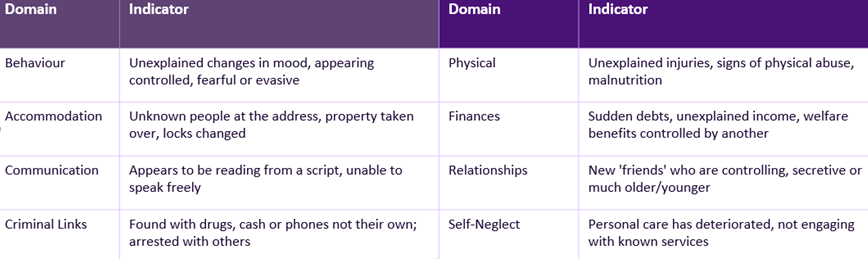
Practitioners should look for patterns of vulnerability, behaviour, and external influence, rather than single incidents. Key indicators include:
Mental Health
Substance Misuse
Social Isolation
Previous Abuse / Exploitation
Disability / Capacity
Socio-Economic Vulnerability
Victim Does Not Identify as Victim
Trauma bonding, fear, dependency on perpetrators and a distorted sense of choice mean most people being exploited do not present as distressed or seeking help. Practitioners must look beyond the presenting picture.
Consent Is Not the Same as Safety
An adult ‘consenting’ to a cuckooing arrangement is not consenting freely. Coercion, debt and fear operate below the surface. The Care Act does not require lack of consent — it requires care needs and risk of harm.
Multiple Complex Needs
Victims typically have overlapping vulnerabilities — mental health, substance misuse, homelessness, offending history. No single agency holds the full picture. Fragmented responses protect no one.
Limited Accommodation Options
Placing victims in safety requires suitable housing. In many areas this is critically short — especially for adults with complex needs, substance misuse histories or criminal records.
Language and Cultural Barriers
Exploitation affects people across all communities. Language barriers, distrust of authorities and cultural shame about exploitation significantly affect disclosure and engagement.
Statutory Thresholds
Not all adults being exploited meet Section 42 thresholds. But below-threshold need still requires a response. Consider Care Act assessment regardless.
Care Act 2014 Adult with Care and Support Needs
S.42 Criteria
1. The person has needs for care and support — whether or not the local authority is currently meeting those needs. This includes people with mental health needs, learning disabilities, physical disabilities, substance use issues, age-related frailty and dementia.
2. Is experiencing or at risk of abuse or neglect –Risk is sufficient, harm does not need to have occurred yet. The person may not acknowledge it.
3. Unable to protect themselves — As a result of their care and support needs, the person cannot protect themselves. This is about capacity in context — not a binary test. Coercion, trauma bonding and fear all affect a person’s ability to protect themselves.
Six Safeguarding Principles
Modern Slavery Act 2015: Offences of slavery, servitude, forced/compulsory labour and human trafficking. Applicable where the victim is trafficked into the property or subjected to compelled activity. Maximum life sentence.
Complete Online Referral (First Responder Only)
Who Are First Responders?
The Role of the First Responder Is To:
National Referral Mechanism (NRM) Decision-Making Process:
Once a referral is made to the National Referral Mechanism (NRM), there are two stages of decision-making:
1. Reasonable Grounds Decision
This is the initial decision stage and is based on the threshold of “I suspect but cannot prove.”
If a positive Reasonable Grounds decision is made, the person is recognised as a potential victim of modern slavery or exploitation and can access immediate support, including safe accommodation, advocacy and other support services.
2. Conclusive Grounds Decision
This is the final decision stage and is based on whether, “on the balance of probabilities, this person is a victim.”
A positive Conclusive Grounds decision confirms an individual’s status as a victim and enables access to longer-term, tailored support, which may include:
Consent and Safeguarding
For adults, informed consent must be obtained before an NRM referral can be made. If an adult does not consent to an NRM referral, a Duty to Notify referral should be completed instead. This records concerns about potential exploitation but does not provide access to NRM support services.
The NRM does not replace safeguarding responsibilities. It works alongside Care Act 2014 safeguarding duties, including Section 42 enquiries where the criteria are met.
See it
Look beyond the presenting issue. Exploitation hides behind consent, minimisation and apparent stability. Use your professional curiosity — always.
Document it
Record what you see, hear and are told — including the person’s exact words. Chronologies matter. Good recording has saved lives and ended criminal prosecutions.
Refer it
If criteria are met — S42 duty is engaged. If not — refer to appropriate safeguarding pathways. Do not hold risk alone. Do not wait for proof.
Escalate it
If agencies are not responding proportionately, escalate. Use the WST safeguarding escalation policy
Challenge it
Challenge victim-blaming language. Challenge minimisation by other professionals. The language of ‘lifestyle choice’ has no place in exploitation work.
Support it
Trauma-informed practice. Build the relationship. Use professional curiosity with warmth. The person’s engagement with you may be the only safety net they have.
