What is contextual safeguarding?
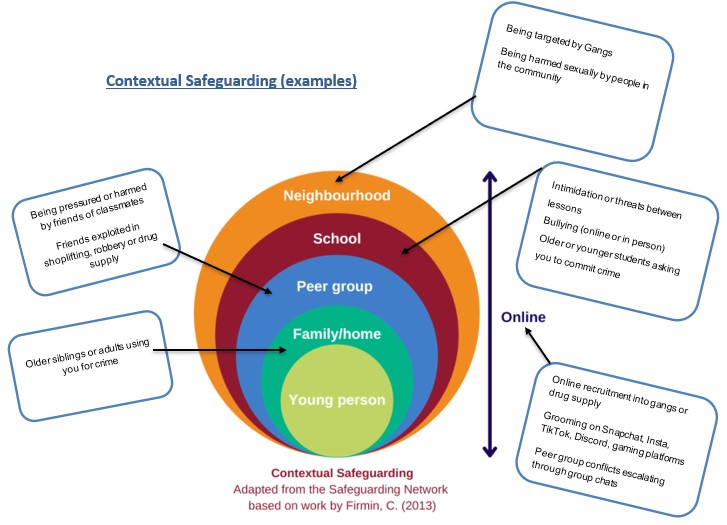
Sometimes you may hear this as ‘harm outside the home’, contextual safeguarding is an approach to understanding, and responding to, young people’s experiences of significant harm beyond their families. It recognises that the different relationships that young people form in their neighbourhoods, schools and online can feature violence and abuse. Parents and carers have little influence over these contexts, and young people’s experiences of extra-familial abuse can undermine parent-child relationships.
Therefore, Family Help Practitioners, child protection systems and wider safeguarding partnerships need to engage with individuals and sectors who do have influence over/within extra-familial contexts, and recognise that assessment of, and intervention with, these spaces are a critical part of safeguarding practices. Contextual safeguarding, therefore, expands the objectives of child protection systems in recognition that young people are vulnerable to abuse beyond their front doors.
Examples of what harm outside the home might look like are shown in the diagram below:
Types of exploitation and harm outside the home can include:
When a child is groomed, manipulated, pressured, or forced into sexual activity. You can find out more about this here.
When children or young people exploit, pressure, or harm other children, often within friendships, relationships, or groups. You can find out more about this here.
When a child is coerced or controlled into criminal activity, such as drug dealing sometimes heard as county lines, theft, or carrying weapons, for someone else’s benefit. You can find out more about this here.
When children are recruited, moved, or controlled so they can be exploited for work, crime, or other forms of abuse. You can find out more about this here.
Children who go missing from home or care, often placing them at higher risk of exploitation, abuse, or harm. You can find out more about this here.
When a child is influenced to adopt extreme beliefs that could encourage hatred, violence, or involvement in harmful groups. You can find out more about this here.
When a child becomes is groomed into groups that may use violence, intimidation, or criminal behaviour to gain power or money. ** Girls can be groomed into gangs just as much as boys.** You can find out more about this here.
When children are groomed, pressured, or harmed through social media, gaming, or online platforms. You can find out more about this here.
Support and resources
You can find out more about Contextual Safeguarding by watching this video from the Global Contextual safeguarding network here.
Access the ‘What is Exploitation’ guide for Parents and Carers here.
If you are worried about contextual safeguarding involving your child or a child you care for, please speak to your child’s school, MASH 24, or another trusted professional for advice and support.