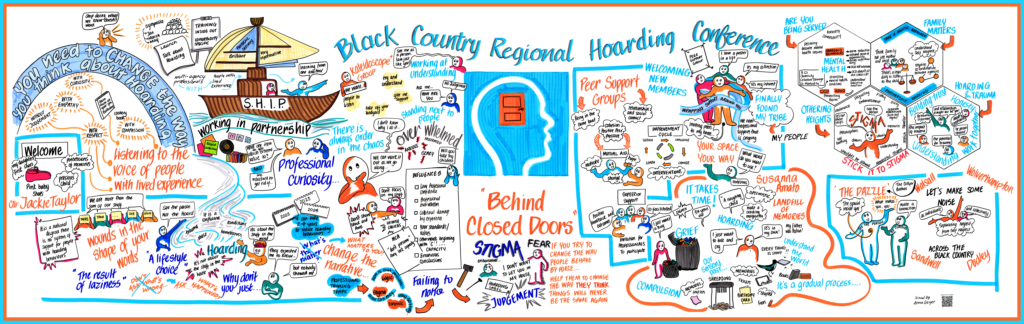


Hoarding

Hoarding is an overwhelming psychological condition defined, in part, when someone cannot discard or part with their items without feeling extremely distressed. 

In short, it is a recognised mental health disorder but, unlike other mental health issues it is constantly defined by what people have in their HOMES, instead of what people have in their HEADS!

Hoarding is poorly understood, and people who exhibit hoarding behaviours are poorly understood.

People who exhibit hoarding behaviours often experience shame, embarrassment and/or self-loathing due to i) the huge social stigma attached to ‘hoarding’ ii) the self-stigma iii) poor support and unhelpful responses and iv) the (far too) common myths.

Keith's story

Birmingham Safeguarding Adults Board produced a film about hoarding – Keith’s story.

This film raises awareness of hoarding and guides professionals on what kinds of interventions seem to work the best so that the people affected (both the person who exhibits hoarding behaviour and other people whose lives this impacts upon) get the support that they need.

The film tells Keith’s story, in his own words, describing how hoarding affected his life and with the right support, his journey to recovery. Professionals (including fire officers, social workers and mental health staff) talk about the challenges hoarding can present and approaches that can help support recovery.

Six years later, in 2023, Keith appeared on the Hoarding Stuff podcast where he opened up about how his life has been impacted and how he has found ways to manage them.

You can listen here: Hoarding Stuff | Calling on Keith

Elizabeth's story

Elizabeth’s story has been compiled by Sandwell’s Safeguarding Adults Board (SSAB), highlighting the dangers that hoarding poses, as well as the lessons learnt from this particular Safeguarding Adults Review.

What support is available in Wolverhampton?

Here in Wolverhampton, we recognise that more support for people who exhibit hoarding behaviours is needed. We’ve been working alongside psychologist Ian Porter (North West Hoarders Helping Hoarders Network) and people with lived experience to improve the help available locally.

Hoarding Focus Group

Are you working alongside a person who is exhibiting hoarding behaviours and would like to explore how best to support them?

Held online every second Tuesday of the month from 2pm – 4pm.

Please email hoardingfocusgroup@wolverhampton.gov.uk with the following details:

  • Name
  • Address
  • Date of birth
  • PER number (if known)
  • Summary of person’s situation

Always try to gain consent from the person to discuss their situation – please highlight why if you are not able to do this.

If the person has care and support needs and is self-neglecting as well as hoarding you should also complete an eMARF: emarf.wolverhampton.gov.uk

Self-Help Support Groups

Dates and locations to be confirmed.

Practice Guidance and toolkit

Under development.

Wolverhampton Hoarding Improvement Partnership

Would you like to be part of the Wolverhampton Hoarding Improvement Partnership? This group meets every other month from 10am – 12pm and acts as the improvement arm of our work, helping to shape and strengthen our local response to hoarding.  The dates are as follows:

Friday 18th September 2026

Friday 20th November 2026

Friday 15th January 2027

Friday 19th March 2027

Friday 21st May 2027

If you’re interested in getting involved, please complete your details using the link below and you’ll receive meeting invites and updates.

Hoarding Improvement Partnership – fill in form

If you have any questions, please email: WSTTraining@wolverhampton.gov.uk

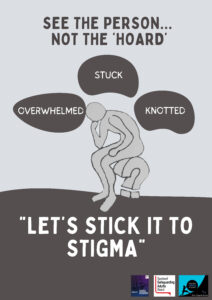
Anti-Stigma Posters

If you would like copies of the posters to print out, please email WSTTraining@wolverhampton.gov.uk 

What you can do if you or someone you know is exhibiting hoarding behaviours?

If you are concerned about your own situation or feel that someone you know may need additional support, arrange to see a GP in the first instance. This may not be easy, as you or a person who exhibits hoarding behaviour may not think that help is needed.

You can also contact the Adult Social Care Front Door on 01902 551199 to discuss your situation or the person you are concerned abouts situation.  You are also able to complete an online Self-Assessment.

In practice, when an adult with care and support needs is at risk of neglect from their hoarding or is at risk from a household member who hoards, then a safeguarding enquiry should be considered and you can do this by contacting the Multi-Agency Safeguarding Hub (MASH) on 01902 551199.

Consent from the adult should be gained wherever this is possible and where the adult has mental capacity to understand the referral being made. However, a refusal of consent should not prevent a referral being made in these circumstances, and this should be explained to the individual where appropriate.

Where children live in the property, and the hygiene conditions within the home present a serious and immediate environmental/health risk to children or the physical accommodation places the child in danger, a Multi-Agency Referral Form (eMARF) must be submitted to the Multi-Agency Safeguarding Hub (MASH). If you have concerns and are not sure if the children meet the threshold, please contact the Multi-Agency Safeguarding Hub (MASH) on 01902 555392 for advice.

Useful links for support

The A to Z of Hoarding

Hoarders helping Hoarders

West Midlands Fire Service

  • Safe and Well Call Centre – 0800 389 5525
  • General calls to WMFS – 03300 589 000

Black Country Healthcare Foundation Trust – Help in a crisis

Our Partners

Wolverhampton@2026. All rights reserved